Vola: Cash Advance & Credit
- 4.7
- Rating
- 500.00K
- Installs
- Free
- Price

 Analysis by App-foxy
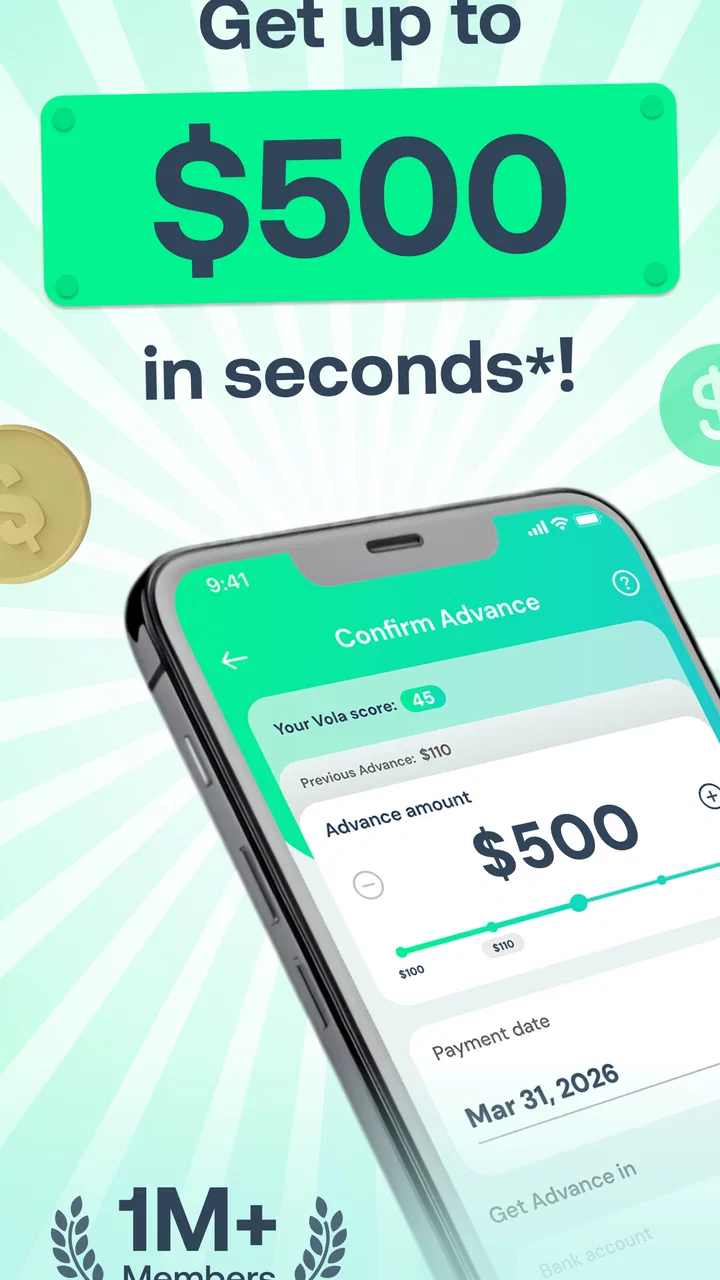
I found Vola most useful when I looked at it as a short-term money-management tool rather than a complete banking replacement. It is a finance app from Vola inc. built around requesting an instant cash advance and receiving payments in real time. That focus makes it relevant in a very specific household situation: one person has a timing problem between income and an unavoidable expense, while another person may be helping them think through the decision.
That distinction matters. A cash advance can solve a gap, but it does not remove the expense or make a tight budget healthier. My overall impression is that this is a convenient option for handling an occasional mismatch between when money is needed and when money becomes available. I would be much more cautious about treating it as regular spending money. The app is free to install, available to Everyone, and has built a solid audience, with an average rating of 4.3 from around 8.9K ratings and more than 500K installs.
How Vola fits into a shared household
The most realistic use case is not a family passing one account around casually. It is a household where one adult owns the financial account and another trusted person helps with planning. Imagine a rent payment, utility bill, or necessary purchase arriving a few days before payday. The account holder opens Vola, reviews the available advance process, and decides whether bringing money forward is safer than missing the payment or using a more expensive emergency option.
You May Also Like

 Google Keep - Notes and lists
Google Keep’s Quiet Growth Shows the Appeal of Simpler Notes
As mobile work gets busier, Google Keep keeps winning a simple contest: capture a thought quickly, find it later, and get on with the day.

 Blood Strike: 2.5 Anniversary
Blood Strike’s Loadouts Turn Every Drop Into a Tactical Gamble
A close look at Blood Strike’s custom loadouts: how fast access to signature weapons reshapes its battle royale rhythm, rewards preparation, and narrows the gap between fights.

 Pandora - Music & Podcasts
Pandora’s Music Is Easy to Start, but Harder to Recover
Pandora’s strength is its low-effort path from a seed to a station. Its weak spot is how much confidence it asks you to place in connection, setup, and quiet recovery.

 8 Ball Pool
 Is Built on Rivalries, Rematches, and Routine
A close look at the rivalries, rematches, shared routines, and unanswered safety questions that turn a quick pool match into a persistent mobile community.

 Samsung Music
’s Quiet Strength Is Playing What You Already Own
Its reach comes less from spectacle than from dependable access to a personal library. That simplicity is both the app’s strongest retention engine and its ceiling.

 AccuWeather: Weather Radar
AccuWeather Review: A Quick, Clear Forecast for Everyday Decisions
For everyday plans, the best forecast is the one you can understand quickly. AccuWeather makes rain timing, radar, and local conditions easy to act on, with a few trade-offs.
More From Our News Desk



In that situation, coordination is more valuable than simply having fast access. I would discuss the request before making it, especially if household finances are shared. The person who needs the advance should remain the account holder, while a partner or trusted relative can help check whether the next income will comfortably cover the repayment and ordinary bills. This keeps responsibility clear instead of turning a shared phone into a shared financial identity.
Vola is not something I would hand to a child to explore. The Everyone content label describes the app’s general content suitability, but borrowing money is an adult responsibility. A younger household member might use the same device for unrelated apps, yet that should not mean they can open a financial session, view sensitive information, or make decisions about an advance. The safest arrangement is a personal device profile, a locked screen, and a clear rule that only the account owner handles the app.
That boundary is especially important because the convenience of real-time payments can make a decision feel smaller than it is. When money arrives quickly, the emotional relief comes before the financial consequence. I found it helpful to treat the request as a mini budget meeting: identify the bill, confirm the next income, and decide what spending will be reduced until the balance is settled. That simple pause is one of the most useful habits to pair with this type of service.
Starting with the right account boundary
Setup should begin with ownership, not speed. I would install the app on the primary user’s device, use that person’s details, and avoid creating an account on a tablet or phone that several people use without a lock. A shared device can be practical, but it creates avoidable confusion around notifications, saved sessions, and who is expected to make the final decision.
The app was released on January 23, 2019, and the current version is 3.4.11. It requires Android 9 or later, so anyone using an older Android phone should check compatibility before planning around it. That requirement is easy to overlook when the need is urgent. In a household, it is worth testing access during a calm moment rather than waiting until a payment deadline is already close.
I also recommend keeping the financial conversation separate from the device conversation. If a partner helps, they can review the household budget together without taking over the account. If a parent shares a phone with an adult child, each person should know whose information is active before opening the app. This is not about assuming bad intentions; it is about preventing an accidental request, an exposed balance, or a notification being misunderstood.
The free price makes trying the app less intimidating, but “free” should not be interpreted as “costless in every respect.” The important question is what the advance means for the user’s next cash-flow cycle and what terms appear during the actual request. I would read every screen before confirming, including any repayment information, eligibility conditions, or optional services shown inside the current flow. Those details should guide the decision more than the fact that installation costs nothing.
Another practical boundary is purpose. I would use the app for a defined short-term need, write down the amount required, and avoid requesting extra money simply because it is available. A smaller advance is easier to absorb than a larger one, and a written reason makes it easier to explain the choice to someone else in the household. This is a modest workflow, but it prevents a quick tool from becoming an unplanned extension of the monthly budget.
Coordinating money without sharing control
Vola works best in a household when everyone understands the plan but only the proper account owner operates the account. For example, a couple could agree that one person checks the upcoming bills while the other opens the app and reviews the request. They can then compare the amount with the next expected income and decide whether the advance genuinely prevents a larger problem.
I would not recommend sending login details through a group chat or leaving an unlocked device on a kitchen counter. Shared financial responsibility does not require shared credentials. If someone needs to help, sitting together for a short review is safer and clearer than allowing several people to sign in independently. It also avoids the awkward question of who is responsible if a request is made by mistake.
A useful household routine is to record three things before confirming: the exact bill, the amount being requested, and the date or income event expected to restore the balance. That record can be kept in a private budget note rather than inside a family chat. It gives both people a common reference point and makes it easier to notice whether the same emergency is happening repeatedly.
The real-time payment angle is convenient when timing matters. If a payment is genuinely urgent, waiting for a conventional transfer or asking a friend for help may not be practical. Still, speed should not replace comparison. A bank overdraft, a credit union option, a planned emergency fund, or a direct payment arrangement with a provider may be better in some cases. Those alternatives can involve their own conditions, but they may fit a recurring expense more responsibly than repeated advances.
My less obvious concern is the “reset” illusion. Once the advance arrives, the original problem can feel finished even though the household has simply moved money from a future period into the present. I would therefore schedule a follow-up budget check immediately. If the next pay cycle already has rent, food, transport, and other fixed commitments, an advance may create a second shortage. The app can help with timing, but it cannot create additional income.
Age, trust, and the meaning of the Everyone label
The Everyone rating is reassuring from a content perspective, but it should not be confused with suitability for every age group. A finance app that facilitates access to cash requires judgment, identity awareness, and an understanding of repayment. I would keep it under adult supervision in any home where children use the same phone, even if they never intend to touch the account.
For an older teenager learning about money, Vola could become part of a conversation about budgeting, but I would not use a live cash-advance account as a teaching toy. A better lesson is to show how a shortfall is calculated, why an advance must be repaid, and how an emergency fund changes the decision. The account owner can explain the process without exposing private account details or allowing the young person to submit anything.
Trust also matters between adults. If household income is pooled, both partners should agree on whether advances are acceptable and what situations justify them. If finances are separate, the account holder should not assume that a partner or roommate will cover the resulting shortfall. Vola may be useful to the person who qualifies and controls the account, but the consequences can still affect shared bills.
I would skip this app entirely for anyone looking for long-term debt consolidation, a traditional checking account, a savings platform, or a replacement for stable income. It is also a poor fit for someone who already relies on advances every pay cycle. In that case, the more valuable next step is a spending review, an income adjustment, creditor communication, or advice from a reputable financial counselor.
What the app does well in everyday use
The strongest point is focus. Vola is not trying to be a broad financial dashboard in the way a conventional bank app might be. Its central appeal is that it connects a short-term cash need with a fast payment process. When the problem is specifically a timing gap, that directness can be easier to understand than navigating a full banking product.
I also appreciate that the app can be discussed in practical terms. A household can ask, “Which bill does this solve, and how will we handle the next cycle?” That is a healthier way to use it than browsing for extra spending power. The interface may make the request feel simple, but the user’s own planning determines whether the decision is sensible.
Its audience size suggests that the concept is familiar to many people, and the rating of 4.3 indicates generally positive reception. I would still avoid treating that score as proof that every user will have the same experience. Eligibility, account circumstances, payment timing, and the exact terms presented to an individual can affect the result. Reviews are useful for spotting recurring friction, but they cannot replace reading the live offer carefully.
The app is also approachable for someone who does not want to open a new traditional bank account just to address one immediate gap. That said, “easier than a bank” is not the same as “better than a bank.” A bank or credit union may be preferable for regular money management, direct deposit, savings, bill pay, or a structured line of credit. Vola makes more sense as a narrowly defined tool than as the center of a household’s financial system.
Where the convenience can become friction
The main limitation is built into the product category: fast access can encourage fast decisions. A user who is stressed may focus on receiving money and skim the conditions. I would slow down at the final review, verify the amount, and make sure the household budget accounts for the next repayment impact. If anything is unclear, I would not confirm until the wording makes sense.
Another limitation is that an advance cannot fix a persistent gap between income and expenses. If groceries, housing, transportation, and debt payments regularly exceed available income, using Vola repeatedly may only shift the pressure forward. In that scenario, a slower but more structural solution is better, even if it feels less convenient today.
There is also a privacy dimension in shared homes. A person may want help without wanting every financial detail visible to a partner, roommate, or relative. The answer is not to share the account broadly. Use private access, discuss only what the household needs to know, and keep sensitive notifications away from a communal lock screen where possible. This is basic device hygiene, but it matters more when money is involved.
Compared with borrowing from a friend, Vola offers a more formal and immediate route, but it removes the personal flexibility that a trusted friend might provide. Compared with a credit card, it may feel more targeted to a short gap, while a card can become a revolving balance if used carelessly. Compared with an emergency fund, it is a fallback rather than a substitute. And compared with a bank app, it is narrower: useful for a particular cash-flow problem, not a full picture of household finances.
My practical decision process
If I were deciding whether to use it, I would start by naming the expense and asking whether it is truly urgent. Next, I would check the next income against fixed bills and essential spending. Then I would compare the available alternatives, including delaying a nonessential purchase, negotiating a due date, using existing savings, or asking a trusted person for help. Only after that would I open the request flow.
I would also keep the requested amount as close as possible to the actual need. Extra cash can disappear into ordinary spending, leaving the user with the same original problem plus a larger future obligation. This is one of the most important trade-offs with any instant-advance service, and it is easy to miss when the interface emphasizes speed.
After receiving money, I would mark the expected repayment impact in the household budget and avoid treating the remaining balance as disposable. If a partner is involved, both people should know which upcoming expense has priority. If the plan no longer works because income changes or another bill appears, address that early rather than waiting for the next deadline.
For new users, I would install it only on a supported Android device, keep the account tied to the responsible adult, and review the current version before relying on it in an emergency. The app is free and rated for Everyone, but those facts say nothing about whether a particular advance is affordable. Affordability comes from the user’s cash flow and the terms displayed during the request.
Vola inc. has kept the product centered on a straightforward need: access to cash when payment timing is inconvenient. That makes it easier to explain to a friend than a complicated financial platform, but it also means the user must supply the broader planning that the app does not replace. I would recommend it only when the gap is temporary, the purpose is clear, and the next income can handle the consequence.
Household verdict
My final view is cautiously positive. Vola: Cash Advance & Credit can be a useful emergency bridge for an adult who understands the commitment and needs money to arrive quickly. Its free entry point, focused purpose, and real-time payment emphasis make it worth considering when a conventional option is too slow or unavailable.
I would not recommend making it a shared household wallet, giving children access, or using it as a routine answer to recurring bills. The best setup is one responsible account holder, private device access, an agreed household plan, and a clear reason for every request. If those boundaries are in place, the app can fit a narrow but real need without confusing convenience with financial progress.
For me, the deciding question is simple: will this advance solve a one-time timing problem, or will it hide an ongoing budget problem until the next cycle? If the answer is the first, Vola may be practical. If it is the second, a savings plan, creditor discussion, income change, or more traditional financial product is likely the better path. That is why I see it as a useful tool in the right hands, but not as a substitute for a household’s financial plan.
FAQs for Vola: Cash Advance & Credit
01What is Vola: Cash Advance & Credit?
Vola: Cash Advance & Credit is a financial app designed to provide users with quick access to cash advances and credit options. It helps users manage their finances by offering small, short-term loans to cover immediate expenses without the hassle of traditional banking procedures. Ideal for situations where you need funds urgently.
02How does Vola determine my eligibility for a cash advance?
Vola assesses your eligibility based on several factors, including your banking activity and financial history. The app connects to your bank account and analyzes your transaction patterns, income, and expenses to determine the amount you qualify for. This process ensures that you receive a cash advance tailored to your financial situation.
03Are there any fees or interest rates associated with Vola advances?
Yes, Vola charges a membership fee for access to its services, which includes cash advances. The fee structure is transparent, and there are no hidden charges. Unlike traditional loans, Vola doesn’t charge interest but instead offers a flat fee, making it easier for users to understand the cost of borrowing.
04Is my personal and financial information safe with Vola?
Vola prioritizes user privacy and security by employing industry-standard encryption and security protocols. The app connects securely to your bank account and never stores your login credentials. Vola’s commitment to data protection ensures that your personal and financial information remains confidential and safe from unauthorized access.
05Can I use Vola if I have a low credit score?
Yes, one of Vola's benefits is that it does not rely solely on credit scores to determine eligibility. Instead, it focuses on your banking activity and financial behavior. This approach allows users with lower credit scores to access cash advances, making it a flexible option for those who might be underserved by traditional financial institutions.
Pros
- Fast and easy cash advances
- No credit check required
- User-friendly interface
- Transparent fee structure
- Quick approval process
Cons
- Limited to small advance amounts
- Requires bank account linkage
- Not available in all regions
- Fees can be high over time
- App crashes occasionally

Vola: Cash Advance & Credit
Gallery